
Can LLMs help solve open MIPs?
Mixed-integer programming (MIP) is a core modeling tool for planning, scheduling, logistics, energy systems, and many real-world applications. However, MIPs are notoriously hard to solve even with state-of-the-art optimization solvers. We ask whether language models can help make progress by accelerating established solver-based workflows. Large language models (LLMs) have recently shown promise in advancing open problems in mathematics. An unresolved MIP instance can likewise be viewed as an "open problem": its variables, constraints, objective, and data define a concrete numerical open problem.
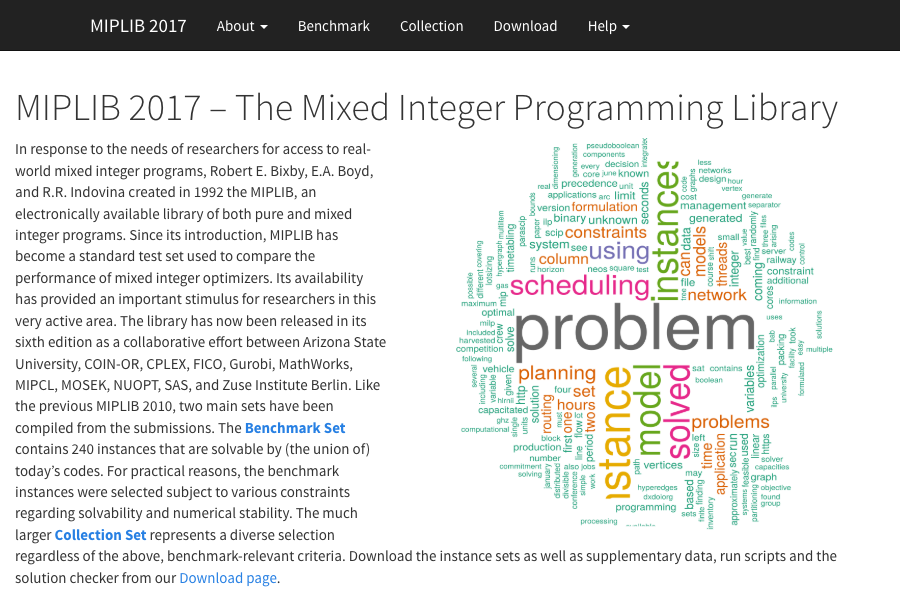
MIPLIB is a public library of real-world mixed-integer programming instances used to evaluate and compare optimization solvers.
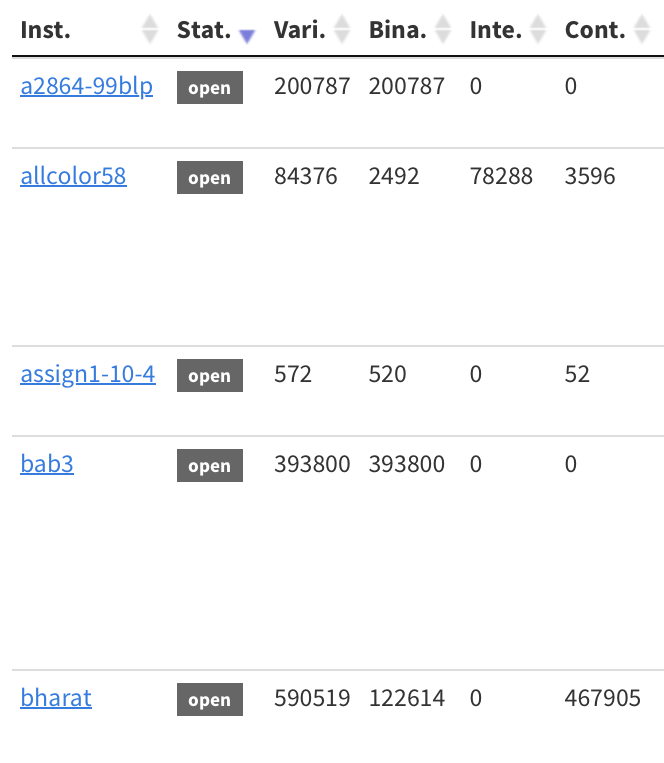
Starting from a benchmark of 217 open MIPLIB instances, we studied 132 with LLM-assisted workflows. LLM reasoning helped search for exploitable structure, primal heuristics, and dual certificates; optimization solvers and independent checks supplied numerical bounds and result verification.
Results on 132 Open MIPLIB instances
| Measure | Count | Explanation |
|---|
Reusable primal and dual skills
We distilled the instance-level analyses into two complementary skills. Each is evaluated against Vanilla prompting and a solver baseline on the same 20 instances.
Primal skill
Find better feasible solutions
Identify useful structure and develop primal heuristics to find or improve incumbents.
Download primal-skillDual skill
Strengthen global bounds
Use structural analysis and solver experiments to develop stronger valid dual bounds.
Download dual-skillExplore the detailed results
Citation
BibTeX · Research website@misc{huang2026llm4mip,
author = {Huang, Yicheng and Gao, Wenzhi and Ge, Dongdong and Udell, Madeleine and Ye, Yinyu},
title = {How Much Can {LLMs} Help Solve {MIPs}?},
year = {2026},
month = sep,
url = {https://huangyc98.github.io/LLM4MIP/},
note = {Research website. Yicheng Huang and Wenzhi Gao are co-lead authors}
}